
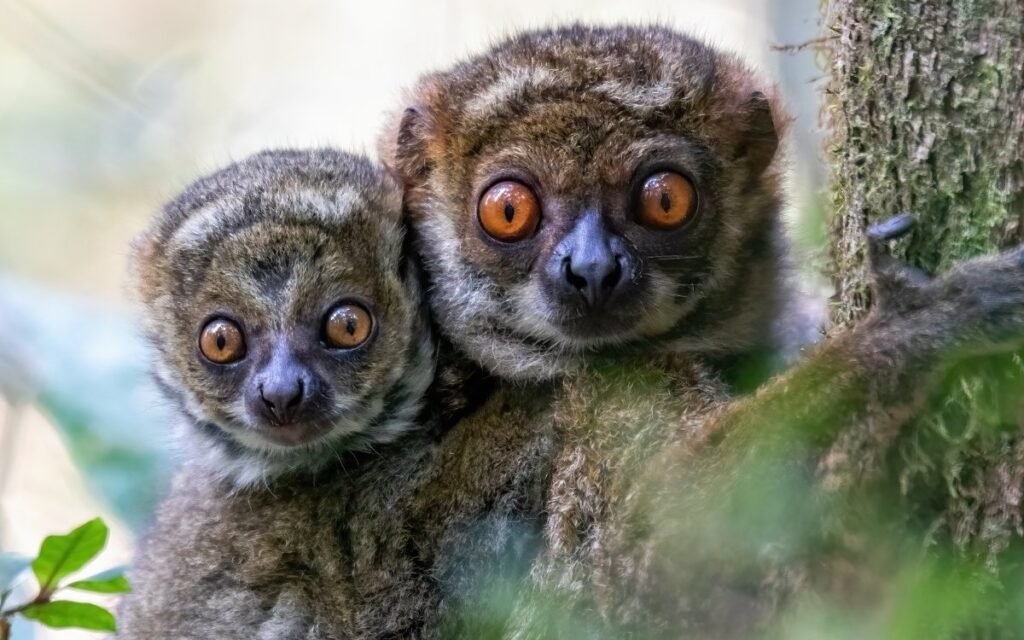
Avahis in Madagascar: Meeting the Nocturnal Woolly Lemurs
In Madagascar’s misty forests, as night falls and daytime sounds fade away, small, fluffy silhouettes slowly begin to stir. Avahis—often called woolly lemurs because of their thick, dense, teddy-like fur—are among the most discreet nocturnal primates on the Big Island. For wildlife enthusiasts on a guided night walk, spotting these gentle creatures is a truly memorable part of any Madagascar safari.
Nocturnal primates with a distinctive coat
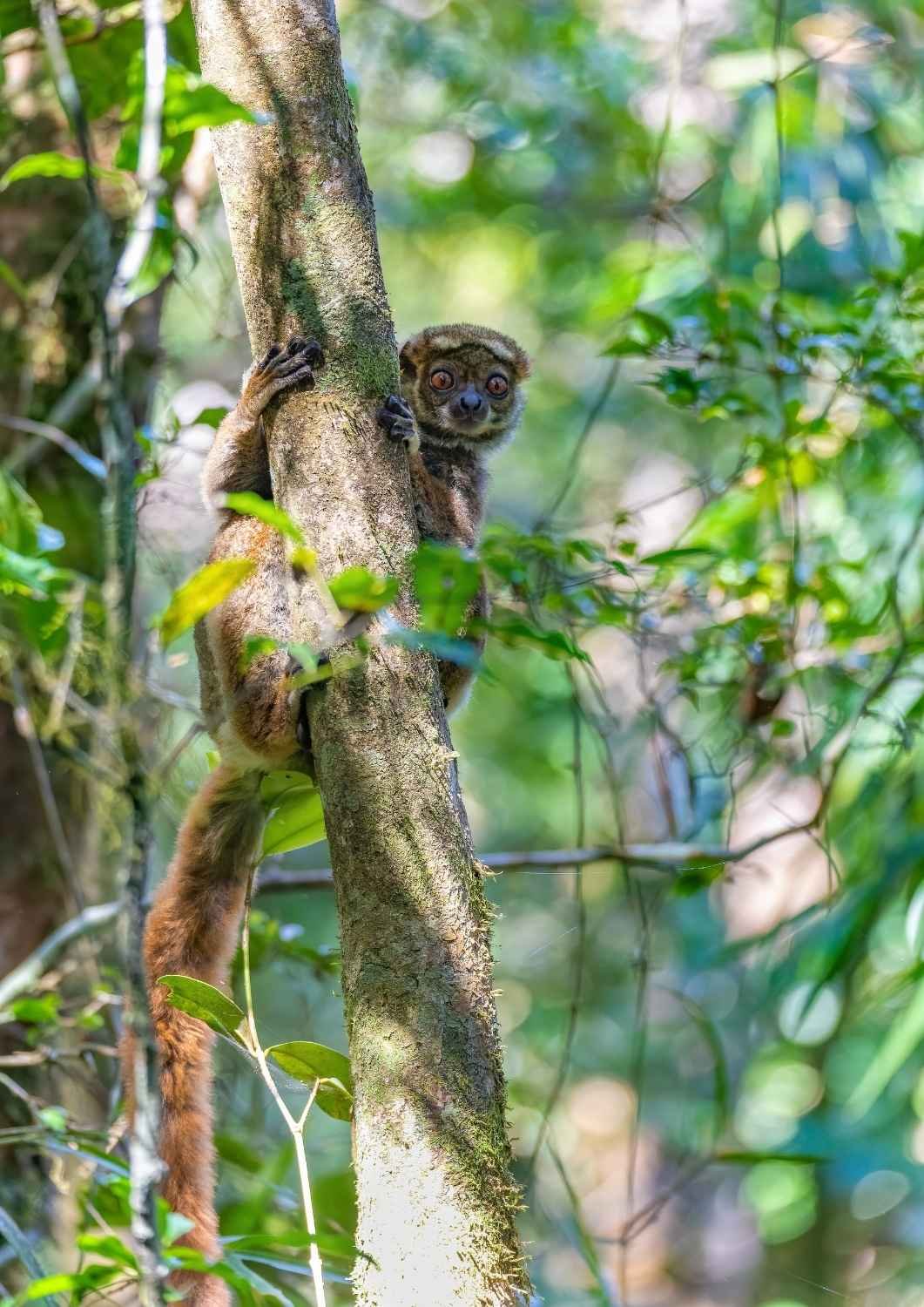
Avahis belong to the Indriidae family—the same family as the famous, loud-calling indris. These small lemurs generally weigh between 600 grams and 1.3 kilograms, with a body length of 27 to 29 centimetres and a tail of roughly the same length. Their thick fur, which earns them the name “woolly lemurs,” ranges from grey-brown to reddish depending on the species, often with a lighter belly and sometimes orange or cream patches on their limbs.
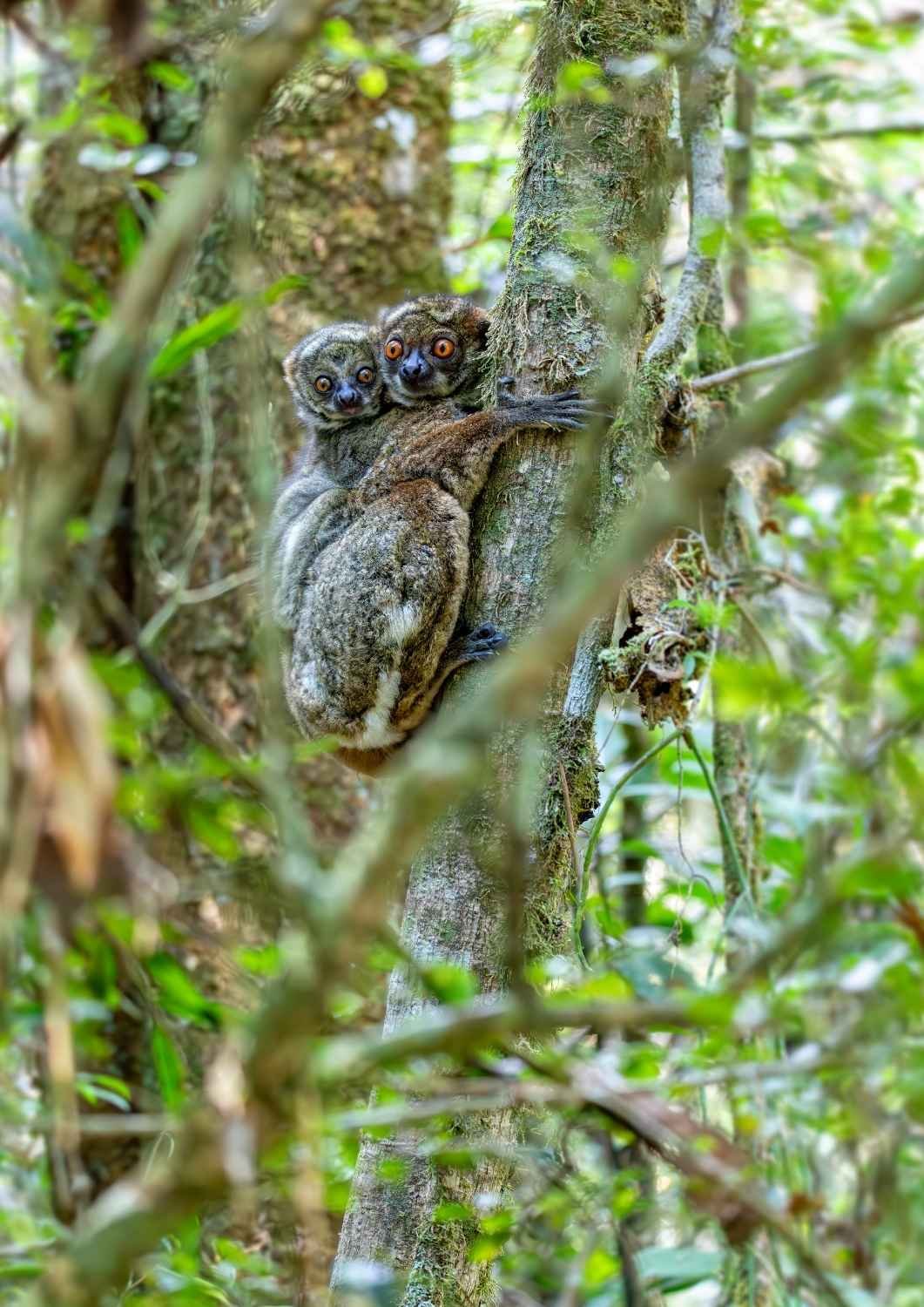
Their large, round, reflective eyes—perfectly adapted for night vision—give them a perpetually surprised look that never fails to charm lucky observers on guided night walks. Unlike their indri cousins, which are diurnal, avahis are strictly nocturnal, spending their days curled up in tree hollows or tucked away in dense vegetation.
A tree-dwelling, vegetarian lifestyle
Avahis are specialised folivores, meaning they feed primarily on leaves. Their diet also includes buds, flowers, and occasionally bark. Because this diet is low in energy, they have a slow metabolism and a generally calm, peaceful temperament. They spend most of their nights moving slowly through the canopy, meticulously selecting the tenderest, most nutritious leaves.
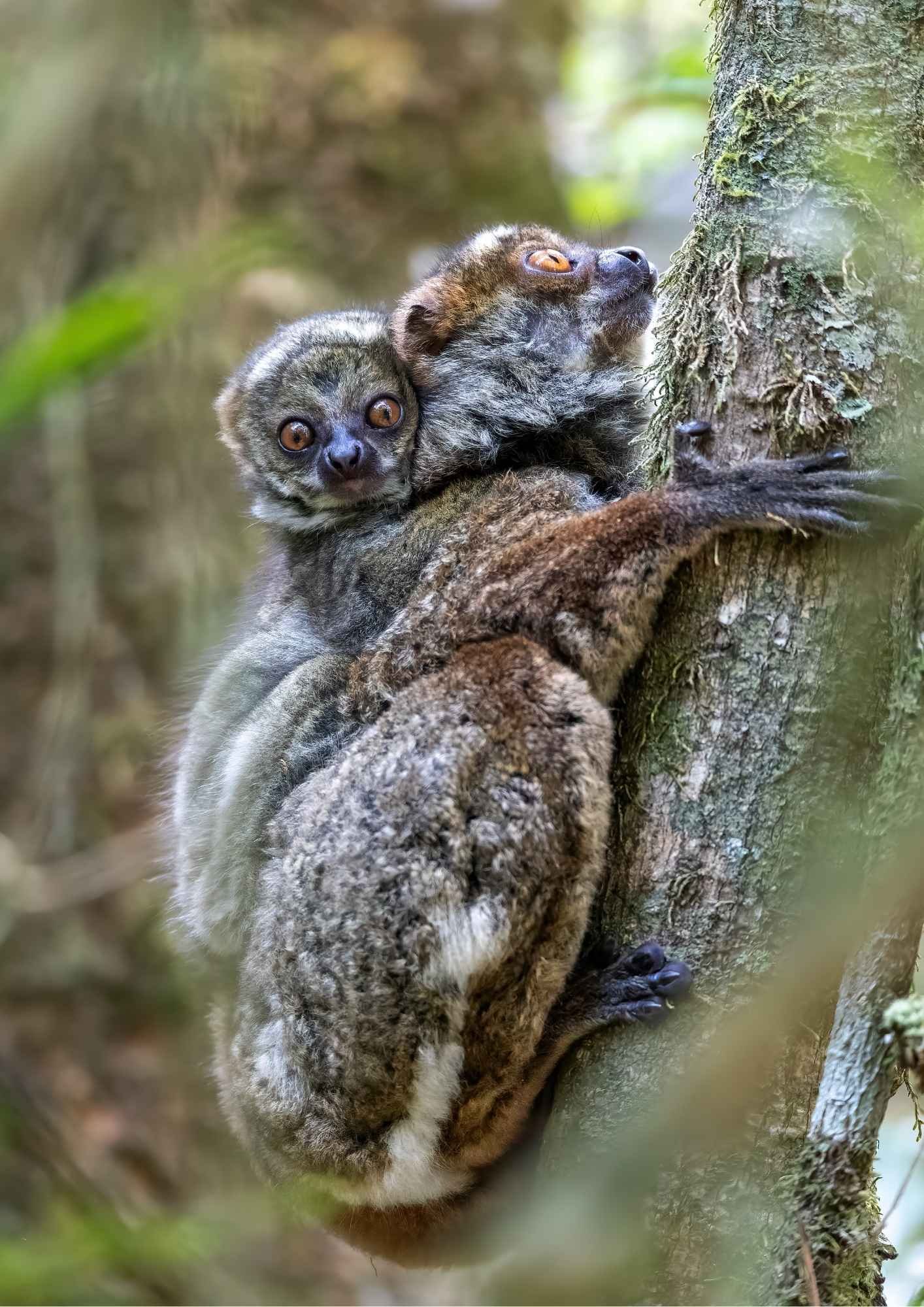
These lemurs are monogamous, living in small family groups made up of a breeding pair and their offspring. A female gives birth to a single baby after a gestation period of about 135 days, usually between August and September. The young lemur clings crosswise to its mother’s belly for the first few weeks before it begins to explore its surroundings.
The 9 species of avahis: A recently discovered diversity
For a long time, it was thought that there were only two species of avahis. However, recent genetic and morphological research has revealed a much greater diversity. Today, nine species are officially recognised, spread across different regions of Madagascar, each adapted to its specific ecosystem.
Summary table of the 9 avahi species in Madagascar
Species | Scientific name | Distribution | IUCN status |
|---|---|---|---|
Eastern woolly lemur | Avahi laniger | East coast (Masoala to Tolagnaro) | VU (Vulnerable) |
Avahi occidentalis | Avahi occidentalis | Western dry forests (Ankarafantsika to Morondava) | EN (Endangered) |
Bemaraha woolly lemur | Avahi cleesei | Tsingy de Bemaraha only | CR (Critically Endangered) |
Betsileo woolly lemur | Avahi betsileo | South-central (Fianarantsoa/Ranomafana) | EN (Endangered) |
Sambirano woolly lemur | Avahi unicolor | North-east (Makira, Masoala) | EN (Endangered) |
Southern woolly lemur | Avahi meridionalis | South-east (Andohahela, Mandena) | EN (Endangered) |
Peyrieras’s woolly lemur | Avahi peyrierasi | Central-east (Mantadia, Zahamena) | VU (Vulnerable) |
Ramanantsoavana’s woolly lemur | Avahi ramanantsoavanai | North-east (Marojejy, Anjanaharibe-Sud) | VU (Vulnerable) |
Moore’s woolly lemur | Avahi mooreorum | East (Ankeniheny-Zahamena forest corridor) | EN (Endangered) |
The 4 most famous avahi species
Eastern woolly lemur (Avahi laniger)
The eastern woolly lemur is the best-known species and the easiest to spot during a Madagascar lemur safari. Found in the rainforests of the east coast—from the Masoala Peninsula in the north down to Tolagnaro in the south—this lemur is recognised by its dense grey-brown fur with reddish tones on its back. Its belly is generally lighter, ranging from pale grey to creamy white.
This species inhabits both primary and secondary forests, adapting relatively well to disturbed habitats; this explains why it is often seen in highly accessible protected areas like Andasibe-Mantadia and Ranomafana. Weighing between 800 grams and 1.3 kilograms, the eastern avahi is slightly larger than its western cousins. Its diet consists mainly of leaves from plants in the Rubiaceae and Fabaceae families. Despite its relative adaptability, the species is classified as Vulnerable (VU) by the IUCN due to ongoing deforestation.
Western woolly lemur (Avahi occidentalis)
Living in the dry deciduous forests of western Madagascar, the western woolly lemur shows remarkable adaptation to an environment very different from that of its eastern cousin. Its range stretches from the Ankarafantsika region in the north down to the Morondava region in the south, in dry forests that drop their leaves during the dry season.
Its fur is generally lighter than that of the eastern species, featuring silver-grey to light-brown tones—an adaptation that aids thermoregulation in this drier environment with sharper temperature shifts. Smaller than its eastern relative, it weighs between 700 and 900 grams. The western avahi has developed a remarkable tolerance to seasonal food availability, adjusting its diet based on which leaves are accessible during the dry season.
This species faces critical threats, as Madagascar’s western dry forests are under intense deforestation pressure for agriculture and cattle grazing. Its IUCN status is Endangered (EN).
Bemaraha woolly lemur (Avahi cleesei)
Formally described in 2005, the Bemaraha woolly lemur is named after British actor John Cleese, the famous Monty Python star, in recognition of his longstanding commitment to the conservation of lemurs and Malagasy wildlife. This honorary naming also aimed to draw media attention to the critical situation of this newly discovered species.
Strictly endemic to the Tsingy de Bemaraha region in north-western Madagascar, Cleese’s avahi is one of the rarest and most geographically restricted species in the genus. It is distinguished by its small size, generally weighing between 600 and 800 grams, and its particularly dense reddish-brown fur with coppery reflections on its head and back. Its ears are relatively small, and its face is rounder than those of other species.
This species lives exclusively in the dry limestone forests of Bemaraha, set against a spectacular landscape of karst formations. Because of its extremely limited distribution and ongoing habitat degradation, it is classified as Endangered (EN). Sightings of the Bemaraha woolly lemur remain exceptionally rare, even for specialised researchers and experienced guides.
Betsileo woolly lemur (Avahi betsileo)
The Betsileo woolly lemur, named after the Betsileo ethnic group that inhabits Madagascar’s southern central highlands, was formally described as a distinct species in the early 2000s. This species is endemic to a relatively restricted area in the humid mountain forests of south-central Madagascar, particularly in the Fianarantsoa region, which includes Ranomafana National Park and surrounding forests.
Medium-sized for the genus, the Betsileo woolly lemur weighs between 700 grams and 1 kilogram. Its fur features a distinctive chocolate-brown back with grey undertones, while its belly is light grey to white. A notable trait is the presence of orange or reddish markings on its limbs, which are particularly visible in some individuals.
Adapted to high-altitude forests between 800 and 1,600 metres, the Betsileo woolly lemur tolerates cooler temperatures than most other avahi species. Its mountainous forest habitat is relatively better preserved than lowland forests, but it still remains threatened by fragmentation. This species can be spotted during night walks in Ranomafana, though distinguishing between the various eastern avahi species in the field remains difficult without genetic analysis. Its IUCN status is Endangered (EN).
This recently documented diversification highlights just how much of Madagascar’s biodiversity remains to be explored and understood, even for relatively common animals. The five other species (A. unicolor, A. meridionalis, A. peyrierasi, A. ramanantsoavanai, and A. mooreorum) have even more restricted geographical ranges and are the subject of ongoing studies to better understand their ecology and conservation needs.
The Best Places to See Avahis in Madagascar
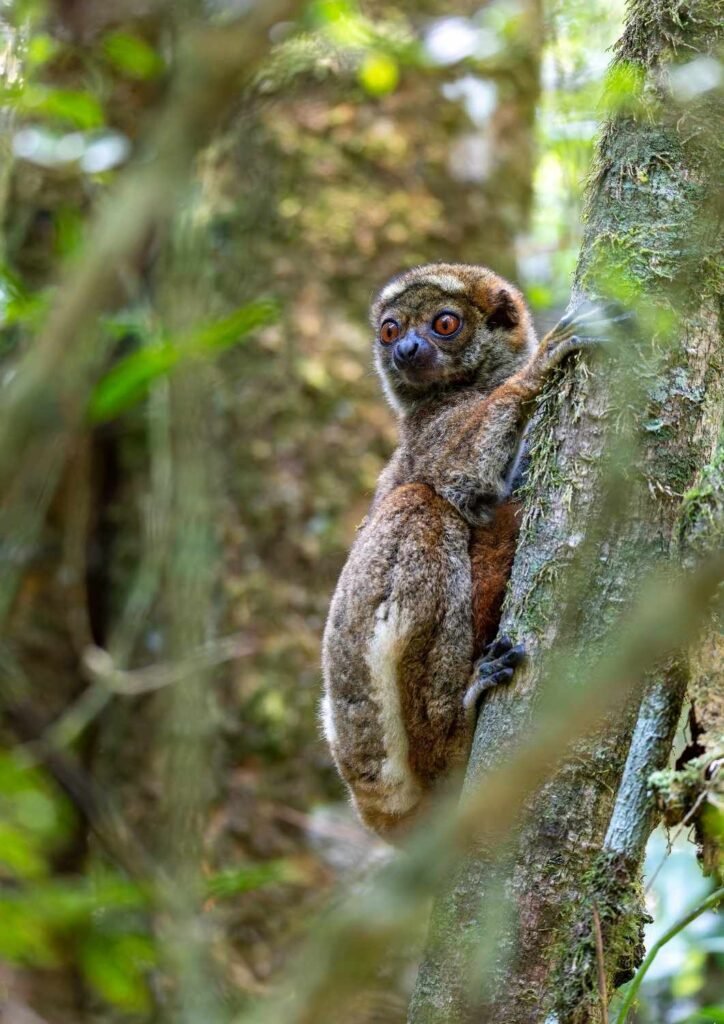
For wildlife enthusiasts hoping to spot these discreet creatures during a Madagascar safari, several locations offer excellent opportunities—especially on guided night walks using red-light headlamps.
Andasibe-Mantadia National Park: The Most Accessible Site
Located about three hours east of Antananarivo by road, Andasibe-Mantadia is arguably the most accessible and reliable place for an avahi night walk in Madagascar. Both the national park area and the nearby Mitsinjo community reserve are home to avahis, notably the eastern woolly lemur (Avahi laniger) and potentially Peyrieras’s woolly lemur (A. peyrierasi).
Experienced local guides know exactly where family groups hold their territories and easily spot their reflective eyes with headlamps after dark. Because it’s so close to the capital, it’s the perfect spot for your first encounter with Madagascar’s nocturnal lemurs. Sighting rates are excellent, particularly between 19:00 and 21:00.
Ranomafana National Park: A Biodiversity Hotspot
Ranomafana, in south-eastern Madagascar, is another prime location for night walks to find avahis. This UNESCO World Heritage rainforest park harbours the Betsileo woolly lemur (Avahi betsileo) in its high-altitude forests. The spectacular, steep terrain makes for highly memorable night-time viewing.
Lemur density here is outstanding, with over 12 different species, and the tourist infrastructure is well developed. Guided night walks typically start near the village of Ranomafana and last two to three hours. It is also a fantastic place to combine daytime watching (golden bamboo lemurs, brown lemurs) with nocturnal discoveries (avahis, mouse lemurs, sportive lemurs).
Ankarafantsika National Park: Avahis in the Dry Forest
In the north-west, Ankarafantsika offers the chance to see the western woolly lemur (Avahi occidentalis) in a unique dry deciduous forest—a stark contrast to the eastern rainforests. This park is also famous for its exceptional birdlife, boasting over 130 species.
Night walks in Ankarafantsika reveal western avahis in their natural dry-forest habitat, an ecosystem that is unfortunately among Madagascar’s most threatened. The best time for sightings here is during the dry season, from April to November.
Masoala National Park: A Primary Forest Adventure
Masoala—Madagascar’s largest protected area, accessible mostly by boat from Maroantsetra—offers a more adventurous, deeply wild avahi-watching experience. This incredibly preserved peninsula is home to multiple species, including the eastern woolly lemur and the Sambirano woolly lemur (A. unicolor), set within a spectacular primary forest bursting with biodiversity.
Spotting them here requires good physical fitness and a multi-day commitment, but you are rewarded with authentic encounters in one of Madagascar’s most pristine ecosystems.
Marojejy National Park: High-Altitude Avahis
Finally, in the north-east, Marojejy rewards fit hikers who climb to its high-altitude camps (such as Camp Mantella at 1,250 m or Camp Simpona at 1,850 m) with the chance to observe Ramanantsoavana’s woolly lemur (A. ramanantsoavanai) in a breathtaking mountain setting among the cloud forests. This park demands excellent physical condition but delivers an unforgettable wildlife experience.
💡 Practical tip: To maximise your chances of spotting avahis on a night walk in Madagascar, head out between 19:00 and 22:00, use a red-light headlamp (which is less disturbing to their sensitive eyes), and always go with a certified local guide who knows the family territories.
Practical Tips for Spotting Avahis on a Night Walk
Observing avahis during a guided night walk in Madagascar takes patience, preparation, and a deep respect for their environment. Night walks should always be done with an experienced, certified local guide—not only to maximise your chances of a sighting, but also to ensure your safety and minimise your impact on the animals.
Recommended gear: A headlamp with a red-light setting is highly recommended, as it disturbs the sensitive eyes of nocturnal lemurs far less than bright white light. Wear neutral-coloured, full-coverage clothing (khaki, green, brown), waterproof hiking boots, and mosquito repellent. A pair of binoculars can be useful, although avahis are usually easy to see with the naked eye at close range.
Ethical behaviour: It is vital to maintain a respectful distance of at least 7 metres, avoid loud noises and sudden movements, and never touch, feed, or use flash photography on the animals. Avahis are delicate creatures whose populations are threatened by deforestation and habitat fragmentation. Your responsible behaviour directly supports their conservation.
Best time to go: Avahis can be seen year-round, but the dry season (April to November) generally offers better hiking conditions. The breeding season, between August and October, can yield particularly interesting sightings as young lemurs begin to appear.
A Heritage to Protect: Avahi Conservation
Like most Malagasy lemurs, avahis face severe conservation threats. The destruction of their forest habitat through slash-and-burn agriculture (tavy), illegal logging, and urban expansion continuously shrinks their territory. Of the nine avahi species, eight are classified as Endangered (EN) and one as Vulnerable (VU) by the International Union for Conservation of Nature (IUCN).
The western dry forests—home to the western avahi and the Bemaraha woolly lemur—are under exceptional threat, with very little of their original cover still intact. This critical situation places these species among the most threatened primates in the world.
Fortunately, conservation efforts are multiplying across Madagascar. National parks managed by Madagascar National Parks and community reserves play a crucial role in protecting these species. Ecotourism, especially through lemur safaris and guided night walks, generates income that directly benefits local communities and provides a strong incentive to preserve the forests.
Research and monitoring programmes led by organisations such as the Groupe d’Étude et de Recherche sur les Primates de Madagascar (GERP) and various international NGOs help us better understand avahi ecology and refine conservation strategies. Creating forest corridors between protected areas is also a major priority to maintain population connectivity and genetic diversity.
Conclusion: A Magical and Responsible Experience
Observing avahis on a night walk in their natural habitat is a true privilege, serving as a reminder of the fragility and uniqueness of Madagascar’s natural heritage. These small woolly lemurs, with their eyes shining in the dark and their delicate movements through the canopy, embody the quiet magic of Madagascar’s forests—and the urgent need to protect them for future generations.
Whether you choose the rainforests of Andasibe or Ranomafana to see the eastern and Betsileo avahis, or venture into the dry forests of Ankarafantsika to find the western avahi, every sighting supports the conservation of these threatened species. By taking part in a responsible lemur safari with certified local guides, you become an active participant in preserving Madagascar’s exceptional biodiversity.
Avahis remind us that Madagascar remains a living laboratory of evolution, where every forest holds biological treasures found nowhere else on Earth. Spotting them on a guided night walk is more than just a wildlife adventure; it is a commitment to conserving an irreplaceable global heritage.
Want to spot avahis on a night walk?
Discover our specialised lemur-watching tours in Madagascar. Expert guides, tailored equipment, and full respect for wildlife.